
Garage Door Off Track: Causes and What NOT to Do
A garage door off track combines a mechanical failure with a strong temptation to fix it yourself in a hurry, because the door looks like it should simply pop back into place. In reality, a derailed door is almost always a symptom of a deeper problem involving springs, cables, or rollers under tension, which is why the wrong quick fix can turn a $150 repair into a $700 one within minutes. At Skyline Garage Door Repair, our licensed technicians in Washington and Florida see this exact scenario several times a week, and this guide walks through the warning signs, the mistakes to avoid, and the point at which the job stops being a homeowner task.
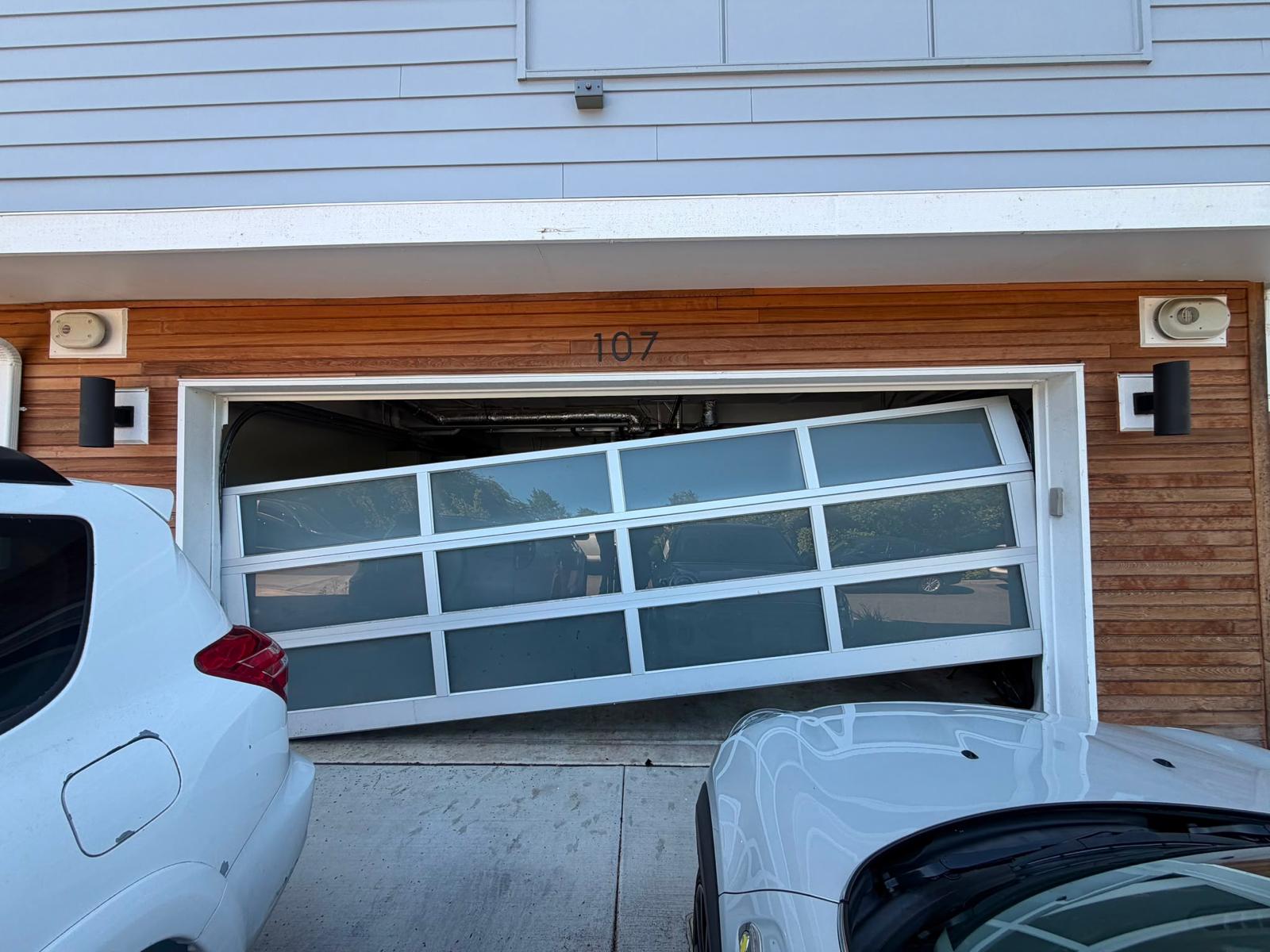
Signs Your Garage Door Is Off Track
Most homeowners do not notice a garage door has come off track until the symptoms are already advanced, because the earliest signs are subtle rather than dramatic. The door might still open and close, just not the way it used to.
Watch for these indicators before the door fails completely:
- The door travels unevenly, with one side rising or dropping faster than the other
- A garage door wheel off track creates a visible gap between the roller and the rail, usually near the bottom or middle panel
- Grinding, popping, or screeching sounds accompany normal operation
- The door stalls partway through its cycle and will not continue in either direction
- One bottom corner sits noticeably lower than the other when the door is fully closed
- The opener strains audibly or reverses on its own before reaching the floor
A door showing even one of these signs is already operating outside its designed tolerances, and continuing to use it daily accelerates wear on the opener motor, the cables, and the rollers that are still seated correctly. Catching the problem at this stage, rather than after a full derailment, keeps the repair in the lower end of the cost range and avoids collateral damage to the panels or the header above the opening.
Common Causes of a Garage Door Coming Off Track
Knowing why a garage door came off track in the first place makes it easier to tell a one-time accident apart from a mechanical pattern that will keep recurring until the root cause is fixed.
Impact Damage
A bumped fender, a stray basketball, or debris thrown against the door during a storm can knock a track bracket loose or bend the rail enough that rollers can no longer travel smoothly through it. In Florida, where wind-borne debris during hurricane season is a recognized hazard under the state building code, a garage door fell off track more than once in our Tampa and Orlando service records after flying yard furniture or tree limbs struck the panel directly.
Worn or Damaged Rollers and Hinges
Nylon and steel rollers wear down after roughly seven to ten years of regular use, developing flat spots or cracks that let them jump the track edge instead of rolling through it, which is one of the most common ways a garage door roller off track situation begins. Hinges connecting the panels loosen the same way over time, and once a hinge bends, the roller attached to it can no longer sit square inside the rail.
Broken or Slack Cables and Spring Imbalance
The door’s weight is carried by a system of torsion or extension springs balanced through steel cables, so a snapped cable or an unevenly wound spring throws that balance off instantly. The door pulls toward the weaker side, dragging the rollers against the edge of the track until they pop free entirely.
Bent or Misaligned Track
Tracks bow inward or outward from age, from a loose mounting bracket, or from someone leaning a ladder against them during unrelated garage work. Even a deviation of a quarter inch over the length of the rail is enough to derail a roller during a full open-close cycle.
Chain or Belt Drive Off Track
Less discussed than roller problems, a chain-drive or belt-drive opener can slip off its own internal rail when the tension adjustment loosens or the drive gear wears unevenly. Homeowners often describe this as a garage door chain off track, but the door panel itself is usually seated correctly and the real fault sits inside the opener rail rather than on the wall-mounted track.
Moisture, Rust, and Seasonal Contraction
Near-constant rain and humidity in the Pacific Northwest accelerate corrosion on unprotected steel tracks and roller bearings, and rust buildup inside the track channel creates friction that eventually forces a roller out of alignment. Metal components also expand and contract with temperature swings, gradually loosening fasteners in both the wet Washington climate and the intense summer heat of Florida garages.
A single cause rarely acts alone. A worn roller riding a slightly bent track, for example, fails far sooner than either problem would on its own, so identifying which factor started the failure determines whether the fix is a quick adjustment or a multi-part repair.
Why an Off-Track Door Is More Dangerous Than It Looks
A residential garage door can weigh between 130 and 400 pounds depending on material and size, and that weight is normally controlled by springs under several hundred pounds of tension. Once an off track garage door starts dragging against its own hardware, that control is compromised in three distinct ways:
- Safety risk: a door hanging unevenly on damaged rollers can drop suddenly, and anyone standing or reaching underneath it during that moment faces a serious crush injury.
- Security risk: a door that will not seal fully against the floor leaves an opening large enough for intruders or pests, and an off-track door frequently cannot be closed or locked at all.
- Cost risk: a bent track dragging against panels scratches, dents, or cracks the door surface, turning a $200 roller repair into a $1,000 panel replacement if it sits unaddressed.
These risks reflect the physics of a heavy, spring-loaded object that is no longer moving along its intended path, not an attempt to make a routine repair sound more urgent than it is. Treating an off-track door as something to handle promptly, rather than as a weekend project, protects both the people around it and the rest of the door assembly.
What NOT to Do When Your Garage Door Comes Off Track
The instinct to force the door back into place is understandable, but it is also the most common way homeowners turn a moderate repair into an expensive one. The mistakes below account for most of the preventable damage our technicians see on off-track service calls.
- Do not force the door up or down manually. Pushing or pulling against a misaligned door stresses the remaining good rollers and can snap a cable that is already under uneven load.
- Do not run the opener repeatedly hoping it clears itself. Each cycle against a bent track or seized roller grinds the metal further out of shape and increases the odds of burning out the opener motor.
- Do not attempt to adjust or release torsion springs yourself. A wound torsion spring stores enough energy to cause severe injury or death if it releases unexpectedly, and no household tool set is designed for this task, online tutorials aside.
- Do not ignore a slightly bent track because the door “still works.” A track that is a few degrees out of alignment today worsens with every cycle, and postponing the fix rarely makes it cheaper.
- Do not use household lubricant, tape, or clamps as a permanent workaround. WD-40 and similar penetrating oils attract dust and grit into the roller bearings rather than protecting them, and improvised clamps can shift under the door’s weight.
- Do not keep parking a vehicle underneath a door that is only partially seated. If the remaining rollers fail while a car sits in the opening, both the vehicle and the door take the damage together.
Each of these shortcuts comes from a reasonable wish to avoid downtime or a service fee, and that trade-off is fine for minor cosmetic issues but not for a system carrying hundreds of pounds under spring tension. Knowing which shortcuts are harmless and which are not is what separates a routine repair visit from a much larger bill.
Safe First Steps Before the Technician Arrives
Before covering how to get garage door back on track safely, it helps to remember that the repair itself belongs to a trained technician; a homeowner can still take several steps to keep the situation from getting worse while waiting for help.
- Stop operating the door immediately, whether by remote, wall switch, or manually, once you notice it is off track.
- Disconnect the opener by pulling the red emergency release cord, which detaches the door from the motorized carriage and stops the opener from forcing further movement.
- If the door is already partway open and appears stable, secure it in place with a clamp or locking pliers on the track above a roller, rather than letting it hang freely.
- Check visually for obvious hazards, such as a snapped cable dangling loose or a section separated from its neighbor, without touching cables, springs, or the drum assembly.
- Photograph the visible damage and note when the problem started, whether after an impact, a strange noise, or gradual worsening, since this speeds up diagnosis.
- Keep the area clear, and if the opening cannot be secured, treat the garage as temporarily insecure overnight.
This list covers the full extent of what a homeowner should attempt, since everything past securing the door and documenting the damage requires tools and training that go beyond a household toolkit.
Minor vs. Major Off-Track Problems: How to Tell the Difference
Not every garage door out of track situation carries the same level of emergency, and learning to separate a minor issue from a major one sets realistic expectations for cost and timeline before the technician even arrives.
| Indicator | Likely minor issue | Likely major issue |
|---|---|---|
| Roller position | Single roller has slipped but the door still hangs level | Multiple rollers are off, or the door hangs crooked |
| Cables | Both cables are intact and taut | One or both cables are visibly slack, frayed, or snapped |
| Sound | Occasional light scraping | Loud grinding, popping, or a sudden bang right before the issue started |
| Door movement | Door still opens and closes, just roughly | Door is stuck, will not move, or moves only a few inches |
| Track condition | Track shows minor scuffing but appears straight | Visible bend, gap, or separation from the wall bracket |
| Timing | Can typically wait for a next-day appointment | Warrants same-day service |
A minor issue, such as one roller popping loose after light contact, is usually resolved in under an hour with a simple realignment and roller replacement costing $150 to $300. A major issue involving a snapped cable, an unbalanced spring, or a badly bent track requires a fuller inspection and often several replacement parts, which stretches both the repair time and the invoice. Because the two scenarios can look similar at a glance, describing the exact symptoms when scheduling service helps the technician arrive with the right parts already on the truck.
How Skyline Technicians Repair an Off-Track Garage Door
A professional garage door off track repair follows a set sequence built to find the root cause rather than simply pushing the door back into its channel, which is why a same-day fix from a licensed technician holds up far longer than an improvised home remedy. The visit typically runs through these stages:
- Disconnect the opener and manually test the door’s balance and roller seating across its full range of motion.
- Inspect the track for bends or bracket separation, and check every roller and hinge for wear.
- Examine the cables and springs for fraying, rust, or uneven tension.
- Realign the track, replace worn rollers with sealed ball-bearing units, or tension and replace cables, depending on what the inspection found.
- Recalibrate the opener once the door itself travels smoothly, confirming the drive rail and limit settings match the newly realigned door.
- Run a full cycle test under load and check that the door seals evenly against the floor.
That last calibration step matters more than it might seem, because a mismatched limit setting on a Genie chain-drive, LiftMaster belt-drive, or Chamberlain smart opener is a frequent reason doors go off track again within weeks of an incomplete repair. This structured process costs more upfront than a five-minute manual push back onto the rail, but it fixes the mechanical cause instead of the visible symptom, which is the main reason professionally repaired doors rarely fail the same way within the following year.
Cost to Fix a Garage Door Off Track
Garage door off track repair cost depends on which components failed and how much collateral damage occurred before the technician arrived, but most jobs fall within predictable ranges.
| Repair scope | Typical cost (USD) |
|---|---|
| Diagnostic visit and minor roller adjustment | $150-$400 |
| Roller or hinge replacement with realignment | $200-$500 |
| Bent track repair or replacement | $250-$600 |
| Cable replacement (single door) | $150-$350 |
| Cable and spring replacement combined | $350-$700+ |
| Full panel replacement due to impact or dragging damage | $500-$2,500 |
Permits are generally not required for like-for-like repairs that leave the opening’s size unchanged, in both Washington and Florida jurisdictions. The exception shows up in Florida’s Wind-Borne Debris Regions, where replacing the entire door assembly rather than repairing it may require verification that the new door meets wind and impact standards, adding roughly $75 to $250 in permit and inspection fees. Delaying repair until a full section or panel needs replacing pushes the bill toward the upper end of these ranges, which is one more reason to address the problem while it is still a roller or track issue.
Washington State: Rain, Moisture, and Track Corrosion
Garages in Seattle, Bellevue, and across the broader Puget Sound region face a climate challenge that generic repair guides tend to overlook: near-constant humidity and seasonal rain that speed up rust formation on unprotected steel tracks, roller bearings, and cable ends. Corrosion inside the track channel raises friction unevenly along its length, and a roller that catches on a rusted section is far more likely to jump the rail during a normal open-close cycle.
Washington’s building code also comes into play when a repair escalates into a replacement, since the Washington State Energy Code sets U-factor standards for garage doors with glazing, requiring a U-0.31 rating for doors under 14 percent glazing and U-0.34 for doors between 14 and 50 percent glazing. A well-sealed, properly insulated door reduces the temperature swings that loosen track brackets and fasteners over successive seasons, which lowers the odds of a repeat off-track failure in a wet climate.
Stainless or galvanized rollers and periodic track cleaning matter more here than in drier regions simply because standard steel components corrode faster in Washington’s climate, so moisture management deserves as much attention as mechanical maintenance.
Florida State: Heat, Storm Debris, and Wind-Driven Impact
Florida’s main off-track risk factor differs from Washington’s, centering on heat, humidity, and the mechanical stress of hurricane-season weather rather than rust alone. High summer temperatures cause metal tracks and fasteners to expand during the day and contract at night, gradually loosening bracket screws in garages across Miami, Tampa, and Orlando that see this thermal cycling repeat for months.
Storm debris adds a more sudden risk, since wind-borne objects striking the door panel during a tropical storm or hurricane can knock a track bracket loose or bend the rail outright. This is the scenario Florida Building Code Section 609.4 addresses for new installations, requiring doors in Wind-Borne Debris Regions and High-Velocity Hurricane Zones such as Miami-Dade and Broward to carry a Florida Product Approval or Miami-Dade Notice of Acceptance and pass large-missile impact testing with a 9-pound piece of lumber fired at 50 feet per second. That code applies to new installations rather than repairs, but homeowners whose door takes repeated impact damage each storm season should weigh whether an impact-rated replacement is a sturdier long-term choice than repairing an older, non-rated door again and again.
A pre-hurricane-season inspection of tracks, brackets, and rollers is a practical way for Florida homeowners to lower the odds of an off-track failure happening during or right after a storm, when repair crews are also hardest to book.
Preventing Future Off-Track Problems
Most off-track failures build up gradually rather than appearing out of nowhere, so a modest maintenance routine catches the early warning signs before the door leaves its rail entirely. Three habits cover most of the wear-related causes discussed earlier:
- A brief monthly visual check of the tracks, rollers, and cables to spot rust, gaps, or slack before they worsen
- Periodic lubrication of the moving hardware with a lithium-based garage door lubricant, rather than a general-purpose spray that attracts grit
- An annual professional tune-up, since a technician can measure spring tension and track alignment with tools that catch deviations long before they become visible to the eye
We cover specific lubrication products and techniques in a separate maintenance guide, but consistent, light attention along these three lines prevents most of the repairs described in this article.
Frequently Asked Questions
The questions below cover how to fix garage door off track situations and the scenarios homeowners ask about most often.
Can I put my garage door back on track myself?
Minor cases, such as a single roller that has slipped slightly without any cable or spring damage, can sometimes be nudged back into place safely once the opener is disconnected. If the door is crooked, a cable looks slack, or you hear grinding noises, stop and call a technician, because the spring tension involved makes further attempts genuinely dangerous.
Is it safe to open a garage door that is off track?
No. Operating a door that has left its track, even partially, risks a sudden drop or a snapped cable, and continuing to run the opener against resistance can also burn out the motor. Treat the door as out of service until it has been inspected.
What causes a garage door to come off track in extreme heat or cold?
Temperature swings make metal tracks, brackets, and fasteners expand and contract, which loosens hardware over time in both directions. Cold weather in Washington makes components brittle and can trap debris in the track, while Florida’s intense summer heat speeds up thermal cycling on unprotected steel.
How much does it cost to fix a garage door off track?
Most repairs range from $150 for a minor roller adjustment to $700 or more when cables, springs, and a bent track all need attention together. An accurate diagnostic quote before authorizing work is the best way to avoid surprises.
How long does an off-track garage door repair take?
A straightforward roller or track adjustment typically takes under an hour once a technician is on site, while jobs involving cable or spring replacement usually run one and a half to three hours depending on door size and the extent of damage.
Can the opener chain or belt cause a garage door to go off track?
Yes. A loose or worn chain-drive or belt-drive rail inside the opener unit can make the door stutter or stop mid-cycle independently of the door’s own track, and technicians often find this is the actual cause after a homeowner assumed the track itself had failed.
Get Your Door Back on Track Safely
The same spring tension and cable system that lifts several hundred pounds of door every day is also what makes an improvised repair risky, which is why an off-track garage door is rarely a simple cosmetic fix. Learning how to put garage door back on track safely comes down to recognizing the early warning signs, avoiding the mistakes covered above, and taking the safe first steps while waiting for help, while realignment, spring adjustment, and cable replacement stay firmly in a licensed technician’s hands.
If your garage door has come off track in Washington or Florida, Skyline Garage Door Repair’s local teams are ready to diagnose the cause and recommend a repair built for your specific climate and code requirements — schedule your free in-home garage door consultation today.